Godzilla
Godzilla is the world's most influential kaiju icon, originating as a manifestation of postwar Japan's nuclear anxieties before evolving into a destroyer, antihero, guardian, and force of nature across numerous continuities. For more than seven decades, the character has remained the defining figure of giant-monster cinema.
Birth of the Atomic Monster
Godzilla, originally named Gojira in Japanese, debuted in Toho's Godzilla (Gojira, 1954). Created in a Japan still living with the legacy of Hiroshima, Nagasaki, and nuclear testing in the Pacific, the original Godzilla was far more than a giant prehistoric creature. He embodied atomic power unleashed beyond human control: an ancient organism awakened and transformed by radiation, returning civilization's own destructive technology against it. Godzilla's devastation of Tokyo therefore functioned simultaneously as monster spectacle and as a metaphor for war, nuclear trauma, technological arrogance, and humanity's inability to fully control the forces it creates.
Showa, Heisei, and Millennium Evolution
During the Showa era, Godzilla underwent one of cinema's most dramatic character transformations. Beginning as an apocalyptic destroyer, he gradually became a rival to other monsters and eventually a defender of Earth against threats such as King Ghidorah, Gigan, and Mechagodzilla. The Heisei era restored a darker and more biologically grounded interpretation within a largely continuous storyline stretching from The Return of Godzilla to Godzilla vs. Destoroyah. This Godzilla remained a catastrophic creature but was also given instincts, relationships, and an increasingly tragic dimension. The Millennium era adopted multiple independent continuities, allowing radically different interpretations ranging from a territorial natural force to the supernatural incarnation seen in GMK and the overwhelmingly powerful combatant of Godzilla: Final Wars.
Reiwa and the MonsterVerse
The Reiwa era expanded Godzilla's conceptual boundaries even further. Shin Godzilla reimagined him as an endlessly adapting organism and a vehicle for examining institutional crisis response; the anime trilogy elevated Godzilla Earth into an almost godlike ecological entity; and Godzilla Minus One returned the character to postwar Japan, using him to embody trauma, loss, guilt, and survival. Legendary's MonsterVerse presents another major interpretation: Godzilla is an ancient Titan and apex predator whose activities are tied to territorial dominance and planetary ecological balance. Rather than behaving as a conventional superhero, this Godzilla protects an order that may or may not align with human interests.
Symbolic Nature and Legacy
Godzilla's extraordinary longevity comes from the character's ability to change meaning without losing his essential identity. The atomic breath, illuminated dorsal plates, unmistakable roar, and colossal silhouette provide a consistent visual language, while the ideas behind them remain highly adaptable. Godzilla can represent nuclear weapons, pollution, environmental collapse, natural disaster, unchecked technology, war, or nature itself retaliating against civilization. Whether portrayed as villain, antihero, guardian, or King of the Monsters, Godzilla repeatedly challenges the assumption that humanity is the unquestioned master of the planet.
Kaiju Profiles & Lineage
Every distinct canonical incarnation of this character across continuities.
Godzilla (MonsterVerse)
Godzilla (MonsterVerse)
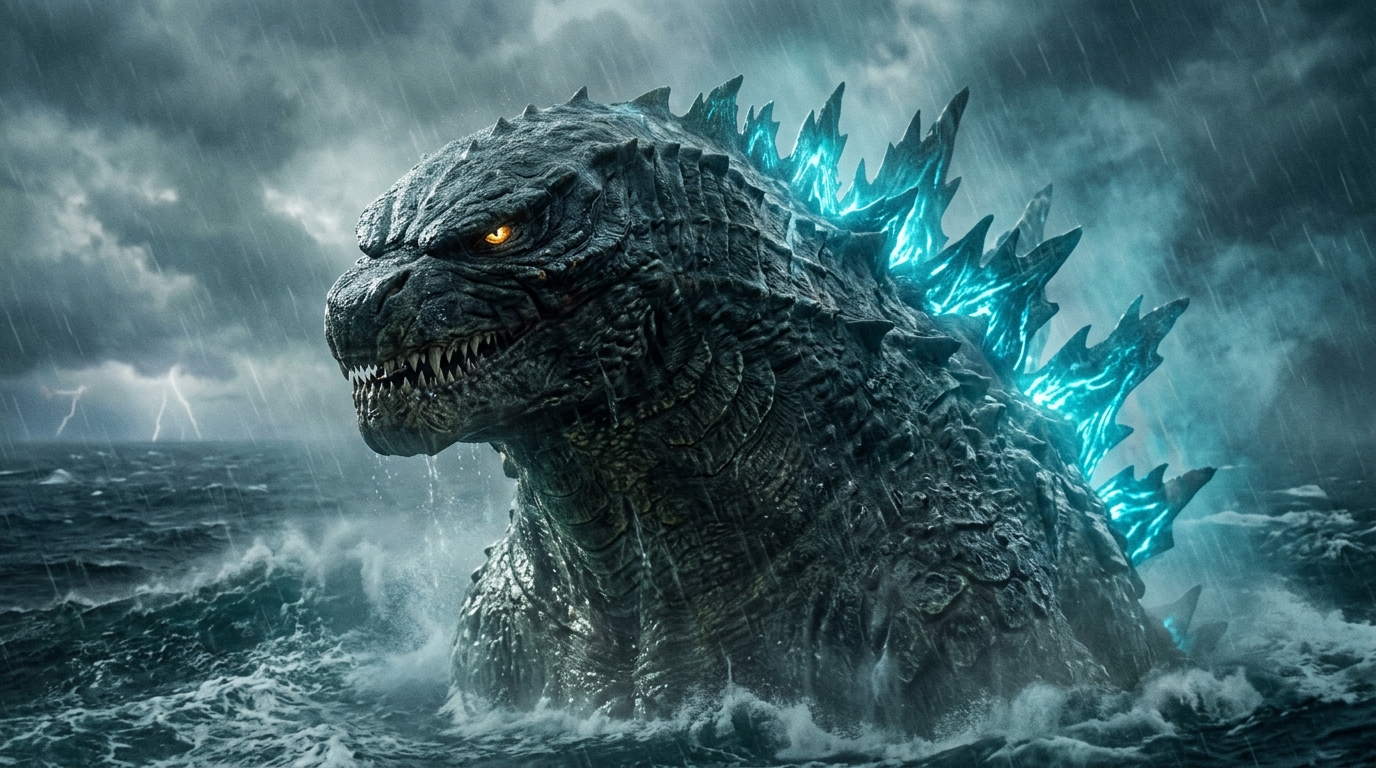
The MonsterVerse Godzilla is an ancient radiation-feeding Titan and apex organism that acts as a regulator of Earth's Titan ecosystem. First publicly revealed during the 2014 San Francisco incident, he has confronted threats including the MUTOs, King Ghidorah, Kong, Mechagodzilla, Skar King and other Titans while establishing himself as the dominant Alpha Titan of the surface world.
Godzilla Earth (DEMO DATA)
Godzilla Earth (DEMO DATA)
Demo sample data for the Ho So Kaiju system. The largest Godzilla incarnation in franchise history.
Godzilla Filius (DEMO DATA)
Godzilla Filius (DEMO DATA)
A 50-meter biological clone spawned from Godzilla Earth's cellular biomass.
Appearances & Filmography
Film, television, and multimedia productions featuring this character.
Godzilla
Godzilla
Godzilla: Planet of the Monsters
Godzilla: Planet of the Monsters
Godzilla: King of the Monsters
Godzilla: King of the Monsters
Godzilla: Aftershock
Godzilla: Aftershock
Godzilla: Dominion
Godzilla: Dominion
Godzilla vs. Kong
Godzilla vs. Kong
Monarch: Legacy of Monsters
Monarch: Legacy of Monsters
Godzilla x Kong: The New Empire
Godzilla x Kong: The New Empire
Franchise Relationships
Allies, rivals, offspring, and counterparts across the franchise.
Mothra
Godzilla and Mothra's relationship varies across continuities: they have fought each other, most notably in Mothra vs. Godzilla, but have also repeatedly united against greater threats. In the MonsterVerse, their connection is explicitly described as an ancient symbiotic relationship between Titans; Mothra fights alongside Godzilla, sacrifices herself during the 2019 Boston battle, and her released energy contributes to the climactic thermonuclear state that follows. In Godzilla x Kong: The New Empire, she again demonstrates her ability to calm conflict and cooperate with Godzilla in preserving planetary balance.
Kong
Godzilla and Kong form one of giant-monster cinema's most iconic rivalries, beginning on screen with King Kong vs. Godzilla in 1962 and later being redefined by the MonsterVerse. In that continuity, the two Alpha-class Titans clash violently over territory, dominance, and circumstances created by human intervention, but eventually recognize threats that require cooperation. From their battle against Mechagodzilla to the conflict involving the Skar King and Shimo, their relationship develops into one of wary mutual respect and persistent rivalry: they are not conventional friends, but two supreme powers capable of forming an alliance when planetary balance is at stake.