The Reiwa Renaissance: Shin Godzilla and Godzilla Minus One — When the Nuclear Nightmare Returned to Its Roots
Analyzing the cinematic revolution of Hideaki Anno and Takashi Yamazaki: from post-Fukushima biological mutation to 1947 post-war trauma and historic Oscar glory.
1. Toho's Reiwa Revolution: Returning to the Primordial Nightmare of 1954

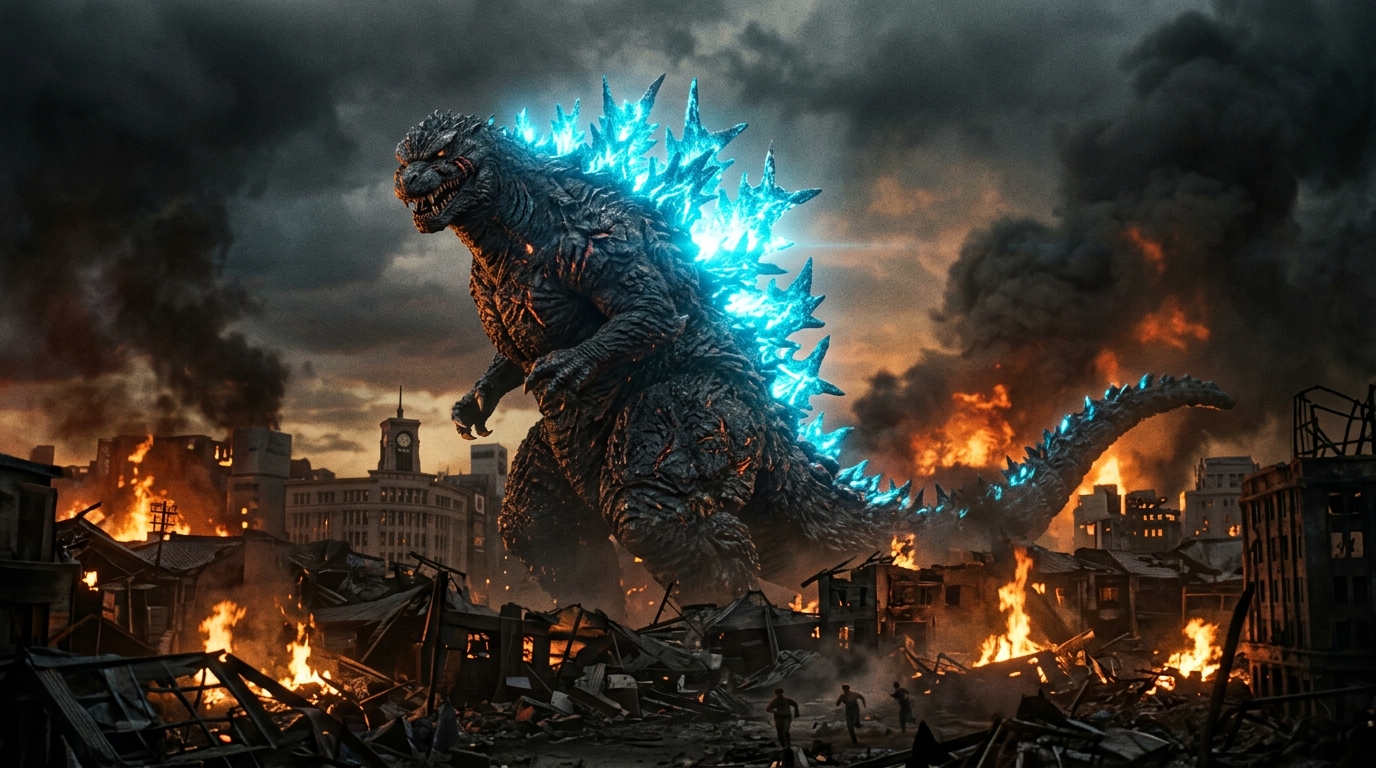
Following Godzilla: Final Wars (2004), Toho placed the King of the Monsters on a twelve-year theatrical hiatus. When Godzilla returned to Japanese screens in 2016—inaugurating the Reiwa Era—Japan's national consciousness had been irrevocably transformed by the March 11, 2011 Tōhoku earthquake, tsunami, and Fukushima Daiichi nuclear disaster.
Rather than continuing monster-versus-monster action spectacles, Toho granted auteur filmmakers complete creative freedom to strip Godzilla back to director Ishirō Honda's original 1954 vision:
- Godzilla as Existential Tragedy, Not Superhero: In the Reiwa live-action masterpieces Shin Godzilla (2016) and Godzilla Minus One (2023), Godzilla stands completely alone. There are no rival kaiju or alien invaders; the central conflict is the desperate struggle of ordinary human beings confronting an overwhelming anthropogenic catastrophe.
- A Mirror of Contemporary Crisis and Historical Trauma: Where Hideaki Anno and Shinji Higuchi's Shin Godzilla delivered a razor-sharp satire of bureaucratic paralysis in the wake of the 2011 Fukushima meltdown, Takashi Yamazaki's Godzilla Minus One turned the clock back to 1945–1947, plunging a devastated post-WWII Japan from "zero" down to "minus one."
- Unprecedented Critical & Academy Triumph: Both films shattered domestic box-office expectations, swept the Japan Academy Film Prizes for Best Picture, and culminated in Godzilla Minus One winning the first Academy Award (Oscar) in Godzilla's 70-year history at the 96th Academy Awards (2024).
[!NOTE]
"After March 11, 2011, Japanese audiences could no longer view Godzilla as a harmless pop-culture mascot. Godzilla had to become a true, walking catastrophe once again." — Director Shinji Higuchi.
---
2. Shin Godzilla (2016): Rapid Evolutionary Mutation & Symphony of Annihilation

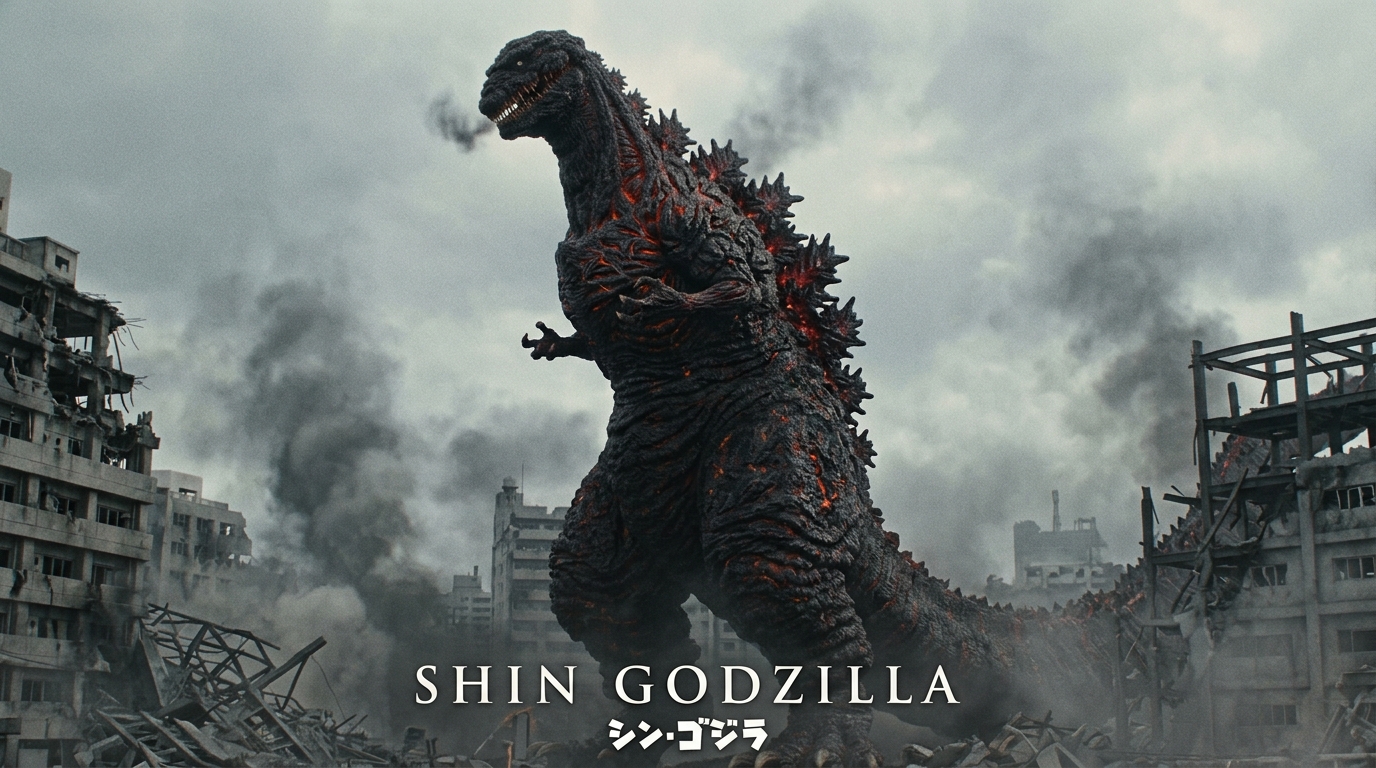
In Shin Godzilla (2016), director Hideaki Anno reimagined Godzilla through the lens of runaway evolutionary biology. Born from an ancient marine organism feeding on dumped nuclear waste containers in Tokyo Bay, Shin Godzilla possesses eight times the genetic information of a human being, enabling spontaneous real-time metamorphosis to overcome any environmental threat:
Four-Stage Rapid Metamorphosis Within Days
- Second Form (Kamata-kun — 28 meters tall): Hauling itself up the Kamata River on rudimentary hind limbs, staring with vacant fish-like eyes while crimson blood-like cooling fluid poured continuously from its gills.
- Third Form (Shinagawa-kun — 57 meters tall): Within minutes on land, its skeletal structure remodeled itself to stand bipedally and develop lungs, until core overheating forced it back into the sea to cool.
- Fourth Form (Kamakura-san — 118.5 meters tall, 92,000 metric tons): Returning ashore as a towering colossus scarred with atomic keloid-like dermis, glowing crimson fissures, and a 196-meter tail sporting a vestigial humanoid structure at its tip.
Multi-Vector Pharyngeal & Dorsal Beams
When U.S. B-2 Spirit stealth bombers pierced its dorsal plates with GBU-57 bunker-buster bombs, Shin Godzilla's autonomous nervous system triggered a terrifying defensive escalation:
- Expelling a massive black cloud of radioactive smoke blanketing Chiyoda, Chuo, and Minato wards.
- Igniting the smoke into a sea of fire before splitting its lower mandible like a serpent, condensing the torrent of flame into a needle-thin violet nuclear laser beam.
- Firing dozens of simultaneous dorsal photon lasers from between its backplates to intercept aerial threats and a secondary beam from its tail tip, turning central Tokyo into a lake of fire beneath Shiro Sagisu's tragic aria "Who Will Know".
---
3. Godzilla Minus One (2023): The Terror of Odo Island & The Black Rain of Ginza

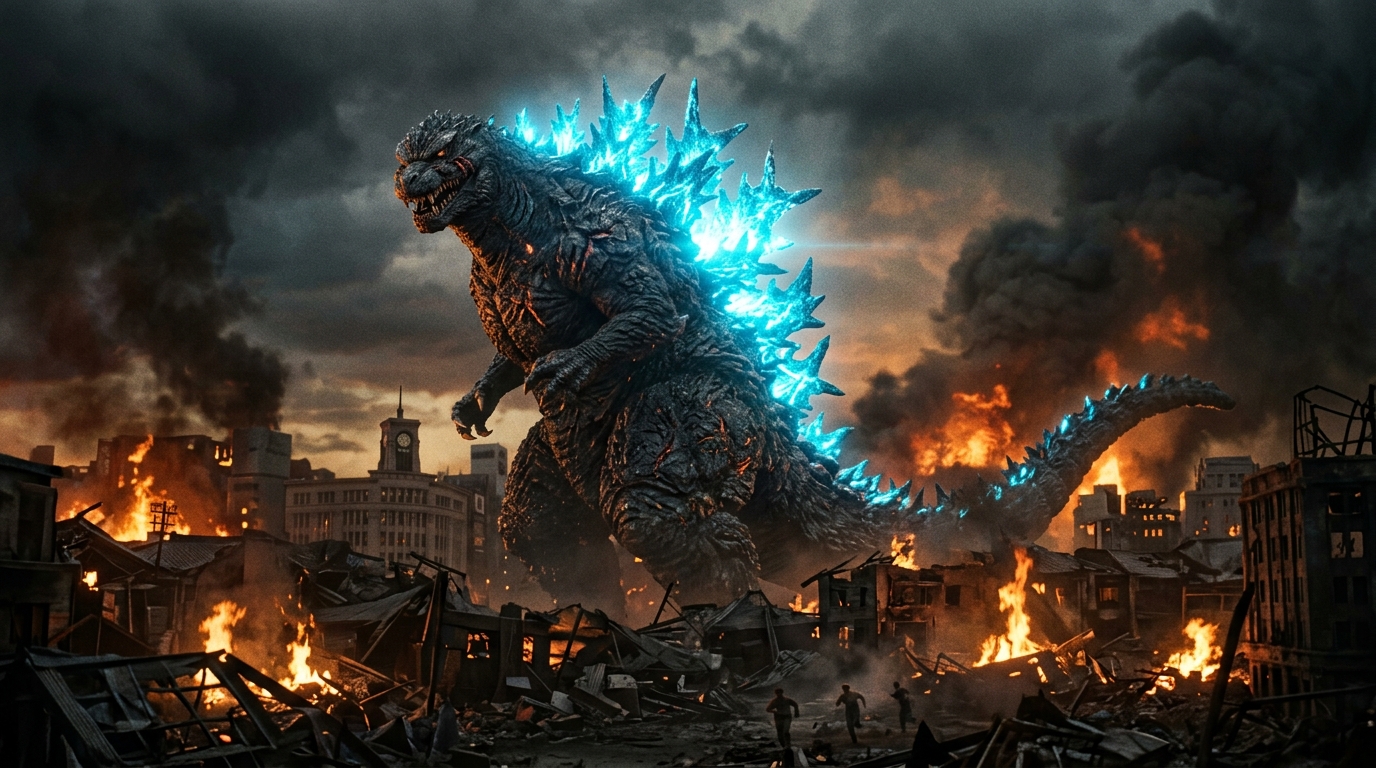
Whereas Shin Godzilla acted as an agonized, impassive force of biology, the Godzilla of Takashi Yamazaki's Godzilla Minus One (2023) is a vicious, actively malevolent predator driven by territorial rage:
- From Odo Island (1945) to Operation Crossroads (1946): In the final days of World War II on Odo Island, deserting kamikaze pilot Kōichi Shikishima encountered a 15-meter theropod-like creature known in local folklore as Gojira. Paralyzed by terror, Shikishima failed to fire his fighter plane's 20mm cannon, resulting in the massacre of the island's mechanics. A year later (1946), U.S. nuclear tests during Operation Crossroads at Bikini Atoll burned and mutated the creature into a 50.1-meter atomic titan.
- Instantaneous Cellular Regeneration: Whether struck by the heavy cruiser Takao's 20.3cm guns or having a naval mine detonated directly inside its mouth, Godzilla's mangled flesh violently bubbled and regenerated within seconds—making every injury mutate its armor into denser, sharper plates.
- Control-Rod Dorsal Locking & The Ginza Mushroom Cloud: Preparing to unleash its Atomic Breath in Ginza (1947), Godzilla's dorsal fins extruded upward one by one from tail to head like nuclear reactor control rods, before slamming violently back into its spine like a firing pin. The resulting heat ray detonated on impact with the force of a tactical nuclear warhead, raising a towering mushroom cloud, flattening blocks via blast wave, and unleashing radioactive Black Rain over the survivors.
[!WARNING]
"This war is not fought so that you may die an honorable death. This war is fought so that we may live to see the future!" — Captain Tatsuo Hotta addressing the civilian-veteran fleet prior to Operation Wadatsumi.
---
4. Comparative Matrix: From the 1954 Original to the Reiwa Incarnations

The Reiwa Era has produced the most scientifically distinct incarnations in franchise history, each honoring the 1954 original while exploring a unique theoretical framework:
| Incarnation | Release Year | Height / Mass | Origin of Mutation | Atomic Breath Mechanics | Human Countermeasure |
|---|---|---|---|---|---|
| Original Godzilla (ShodaiGoji) | 1954 | 50 meters / 20,000 tons | Prehistoric marine reptile awakened by Bikini H-bomb tests | Incandescent radioactive vapor melting steel structures | Dr. Serizawa's chemical Oxygen Destroyer |
| Shin Godzilla (Fourth Form) | 2016 | 118.5 meters / 92,000 tons | Ancient marine organism feeding on dumped nuclear waste | Black smoke -> Fire -> Focused violet laser from jaw, back, and tail | Operation Yashiori: Blood coagulant injection freezing it solid |
| Godzilla Ultima (Singular Point) | 2021 | 100 meters / >60,000 tons | Higher-dimensional Singular Point entity manifesting via Red Dust | CCTC Molecular Laser ringed by spacetime-warping gravity hoops | Jet Jaguar PP triggering the Orthogonal Diagonalizer code |
| Godzilla Minus One | 2023 | 50.1 meters / 20,000 tons | Odo Island creature mutated by Operation Crossroads (1946) | Dorsal fins extend like reactor rods, firing a nuclear warhead beam | Operation Wadatsumi: 1,500m deep-sea decompression + Shinden strike |
The near-identical height (50m vs. 50.1m) and mass (20,000 metric tons) shared by Godzilla (1954) and Godzilla Minus One (2023) stand as a deliberate tribute by director Takashi Yamazaki to Ishirō Honda's foundational masterpiece.
---
5. Operations Yashiori & Wadatsumi: When Humanity Saved Itself

The most profound thematic triumph uniting Shin Godzilla and Godzilla Minus One is how humanity prevails: not through fictional super-weapons or foreign military intervention, but through scientific ingenuity, civilian solidarity, and the refusal to surrender life:
Operation Yashiori (Shin Godzilla - 2016)
Facing a United Nations ultimatum to drop a thermonuclear bomb on downtown Tokyo to eradicate Shin Godzilla, Rando Yaguchi's task force of young scientists and civil servants raced against the clock:
- Deciphering Professor Goro Maki's origami-folded molecular structure to mass-produce hundreds of thousands of liters of nuclear blood coagulant.
- Deploying waves of unmanned drones and explosive-laden无人 Shinkansen bullet trains into Shin Godzilla's legs to drain its photon laser reserves and knock the 118.5-meter titan down onto Tokyo Station.
- Rolling crane-mounted concrete pump trucks directly up to Godzilla's jaws to inject the coagulant down its throat—freezing Shin Godzilla into a monumental stone statue in the heart of the capital and sparing Japan a third nuclear bombing.
Operation Wadatsumi (Godzilla Minus One - 2023)
In 1947, with the Japanese government bankrupt and U.S. forces refusing to intervene out of Cold War tensions with the Soviet Union, private citizens and Navy veterans banded together to execute naval engineer Kenji Noda's bold plan, Operation Wadatsumi:
- Deep-Sea Rapid Decompression: Two disarmed destroyers, Yukikaze and Hibiki, encircled Godzilla in the 1,500-meter Sagami Bay trench with cables lined with Freon gas tanks. Releasing the Freon enveloped Godzilla in low-density gas bubbles, stripping away water buoyancy and plunging the monster down to 1,500 meters in seconds to crush it under extreme hydrostatic pressure.
- Explosive Ascent: Immediately afterward, giant CO2 lift balloons were inflated while a flotilla of civilian tugboats hauled Godzilla rapidly back toward the surface to induce lethal barotrauma decompression.
- The Flight of the Shinden: When a barotrauma-scarred Godzilla still breached the surface and locked its dorsal fins to incinerate the fleet, Kōichi Shikishima piloted a custom Kyushu J7W Shinden fighter packed with two aerial bombs straight into Godzilla's open mouth—yet at the last second, pulled the newly installed ejection seat to live for Akiko and Noriko. The internal detonation caused Godzilla's own nuclear energy to blow its head apart from within, bringing the post-war nightmare to an end and earning Japanese cinema historic Academy Award glory.
Related Canonical Entities
Canonical Kaiju profiles and universes referenced in this editorial

Sources & Bibliography
Official publications, film archives, and canonical guidebooks
- 1The Art of Shin GodzillaOfficial Primary• Ground Works / Toho• (2016)
- 2Godzilla Minus One Official Theater ProgramOfficial Primary• Toho Co., Ltd.• (2023)
- 396th Academy Awards Visual Effects Dossier: Godzilla Minus OneOfficial Primary• AMPAS• (2024)
Related Stories & Editorials
Continue exploring related articles
Kong and Skull Island: The Age of Dominance, The Skullcrawler War, and the Fall of Paradise
An exhaustive historical survey of Skull Island and Kong's evolutionary odyssey: the open-air subterranean ecosystem, symbiotic communion with the silent Iwi tribe, growth metric scaling from 31.6m to 102m, and the subterranean exodus to his ancestral throne.